

We're Having The Wrong AI Debate
AI won't replace you, but someone using it might.

“Will AI replace me?” This is probably one of the most common concerns for modern workers, but I believe it’s the wrong question to ask. The question we should be asking is “Will someone using AI replace me?”
This isn’t just semantics, but a fundamental difference in how we approach what may become one of the AI impacts people feel the most.
The first question can really be boiled down to how far the technology has come. While it’s come incredibly far in a short time period, no, AI itself will likely not be entirely replacing humans for most professional roles.
However, research shows that professionals with AI experience are replacing those without it. The threat isn’t the technology—it’s the colleague who produces 3x the output or builds tools that get noticed by leadership. While AI won’t replace entire roles, it dramatically amplifies the capabilities of those who know how to use it effectively.
The Massive Upskilling Gap
New research from BCG surveying 1,250 companies worldwide puts hard numbers to what I’ve seen firsthand. The companies that are actually generating value from AI—BCG calls them “future-built”—plan to upskill 50% or more of their workforce in AI this year. The laggards? Just 20%.
Another major difference between these two groups is their approach to getting employees on board with AI. Leaders carve out dedicated time for AI learning and training and are avoiding the too-common “figure it out yourself” strategy.
The approach of simply giving people a target for the amount of time they must use AI treats it as just another task.
If it’s not presented any differently than a new email marketing software the team needs to use, the staff usage and results will suffer considerably. Until your staff is able to see and experience the impact of AI in person—more importantly in a workflow or process tied to their role—they won’t have a clear answer as to why it’s so imperative.
The Problem is Compounding
This huge gap between companies seeing AI value and those seeing none isn’t static, it’s growing faster and faster. Professionals who learn to use AI effectively right now don’t just have a temporary advantage; they have a compounding one. As their knowledge and ability increase, so too will the impact on their output.
This is where the importance of support for AI initiatives from senior leadership is a major factor. The important distinction is that the support must be for specific projects tied to attainable goals, not just a company-wide letter announcing an “expectation that all employees be using AI.” This makes it something they have to do, and not what it really is, an opportunity to make themselves more valuable professionally.
What Actually Works
I see 4 primary elements that can be found in any successful AI project. Broadly, these elements show companies that get very specific with use-cases, take AI training seriously, invest time deliberately, and focus on repeatable processes.
AI is a skill and must be treated as a proficiency, not an interest.
Companies that look at AI the way previous generations looked at Excel—as a baseline competency—are building more skilled workforces.
Companies not investing in upskilling their teams are making the bet that this technology won’t stick around long enough to become standard. I wouldn’t take that bet.
Focus on core work, not generic productivity.
ChatGPT isn’t valuable because it helps you write emails faster. The real value comes when it shortens the time of your workflows to the point where you can actually spend time writing important emails yourself.
Per BCG data, 70% of AI value comes from core business functions, not support tasks.
This means leveraging AI to automate/reduce the timelines for marketers, sales reps, project managers, and their management.
In practice, this could be an AI analysis tool that analyzes a rep’s accounts and outputs a table of accounts, recent and relevant press, a recommended angle for outreach, and finally a priority score based on CRM data analysis.
This is so valuable because this is the very information that helps sellers sell more effectively, but the time it takes to do all that manually could be another whole position.
Focus on Systemic Capabilities, not one-off tools.
Keeping your team aligned around common objectives for leveraging AI is a good place to start with a strong central foundation.
This means the process for building something new is customized to ensure all new tools can connect to and build on the previous and upcoming.
Set Time Aside for Dedicated Training.
Companies succeeding with AI set aside more than 4x the time of the laggards in dedicated training.
Implement regular AI training on a daily or weekly basis to ensure equal skills across your team.
Where to Focus Efforts for AI Implementations
Too many leaders focus their AI efforts on broad, sweeping initiatives like setting company-wide AI usage quotas for all employees or giving the entire company access to the same agent and expecting to see measurable improvements. It doesn’t work.
BCG’s latest report shows that 70% of AI value comes from core business functions across sales, marketing, project management, and research. What’s not included is the one area where most businesses focus: customer support.
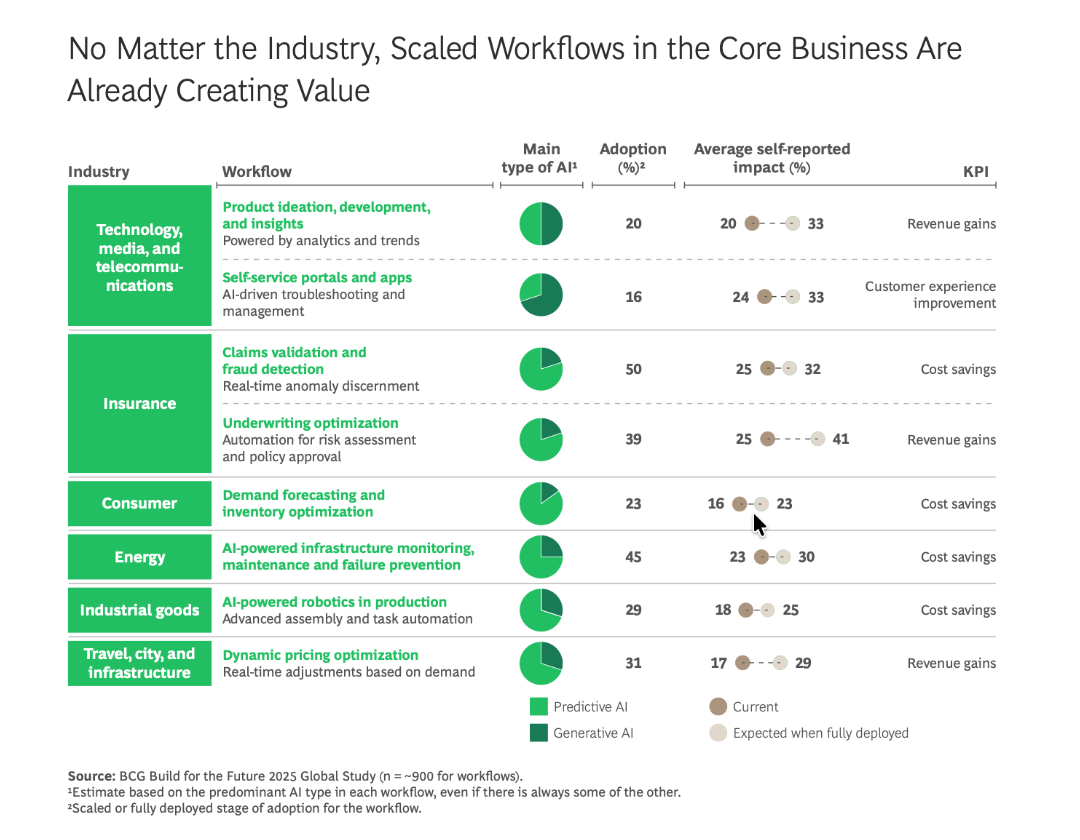
First, the focus needs to shift from employee replacement to highly targeted performance improvement and optimization. For a salesperson, this might mean leveraging AI to analyze pipeline, evaluate trends historically, and provide a data-driven recommendation on the highest-probability opportunities. For a marketer, using AI to conduct deeper analysis on audience segmentation or content performance and provide more actionable reporting.
This approach requires companies to identify the processes and workflows within the core business functions that eat up the most time and resources. Once these are identified, building tools to specifically optimize these workflows will produce measurable improvements.
The Choice Ahead
AI won’t be taking your job, but someone who knows how to use it well certainly might.
That person could be a colleague or new graduate who grew up with these tools in their life.
That person could also be you, a version of you that decided to take AI seriously (not generate cat images).
The number of free resources is endless. A year from now, you’ll be wishing you started today.